Success stories
Each story showcases unique challenges and the innovative strategies used to overcome them, demonstrating the potential for space technology to drive progress and innovation across various industries.

Sharing Energy with Space Technology
The Austrian start-up energyfamily enables energy communities to efficiently manage their electricity consumption in real time. Three European Space Agency (ESA) patents help to reduce data volumes by up to 85 percent and increase the proportion of solar energy used for self-consumption.
Energy communities comprise groups of households, businesses or local authorities. They aim to generate electricity collectively and share and consume it locally. To optimise their solar power consumption, two pieces of information that have virtually been unavailable until now are needed:
1) How much energy is currently being generated?
2) How much energy is currently being consumed?
The Lower Austrian start-up energyfamily is solving this problem by using space technologies. Powered by ESA SPARK Funding Austria, the ‘flexiCo’ project enables energy flexibility with real-time communication. How? It uses three ESA patents to efficiently compress, stream, store and analyse real-time data of generated and consumed energy. This benefits energy community users by enabling greater self-consumption of solar power, lower energy costs and more efficient use of battery storage, heat pumps and electric vehicles.
The Challenge: Real Time Energy Data
Grid operators‘ smart meters only provide data the following day, and even then only at low resolution. Conducting their own measurements every two seconds generates huge amounts of data that must be transmitted, stored and analysed.
What is needed is real-time distributed energy management. ‘Only when an energy community can see in real time what it is consuming and producing can it truly manage its own consumption. Until now, the necessary data has simply been lacking’, says Lukas Prenner, founder and CEO of energyfamily. His start-up is already helping 350 active energy communities, supporting them with everything from establishment to administration and offering them a digital platform for managing their solar power.
Prenner addresses problems such as the high temporal variability of renewable energy as well as mismatched production and consumption curves. In practice, optimising the balance between consumption and production means battery energy storage systems can be charged to capacity, heat pumps can be controlled efficiently and electric cars can be charged – all at the optimal time when the most energy is available.
The Solution: Space Technology by ESA
To achieve this, energyfamily combines two components into a single integrated system. On the hardware side, small smart meter adapters and independent measuring devices are installed. On the software side, a cloud platform aggregates data from all communities, analyses it and provides users with the results.
To ensure the economic viability of this level of detail, the three ESA patents come into play. ‘What the ESA has achieved for its satellites is exactly what we need on the ground for the energy transition: lots of sensors, low bandwidth and precise data at all times’, explains Prenner.
The three patents originate from the world of satellite telemetry. Satellites, like a distributed energy measurement system, constantly produce high-frequency measurement data, but can only transmit a limited amount of data to Earth per second and have limited on-board computing power. The ESA has developed efficient methods that can be applied directly to smart meter data precisely for this purpose.
Data compression will be much more efficient due to an efficient algorithm. It reduces measurement points by up to 85 percent– still more than enough to reconstruct the original data. In turn, data storage will be simplified, meaning that only a small amount of data needs to be stored locally in the smart meter, sensor or cloud. And the anomaly detection process analyses data to identify problems. Users will be informed immediately, for example in the event of a battery energy storage system failure.
The Conclusion: 85% less data
‘With these three ESA patents, we have been able to reduce the data footprint by up to 85 percent. This turns a theoretically interesting service into an economically scalable product’, concludes Prenner. Assuming a scale-up to one million users, this equates to annual cloud storage cost savings of several hundreds of thousands of euros per year. Furthermore, anomaly analysis leads to efficiency gains, partly because the self-consumption rate of solar power can be increased, meaning less energy needs to be purchased.
‘This project is an excellent example of how space technologies can create value far beyond the space sector. By adapting ESA-developed data processing methods for energy communities, energyfamily demonstrates how know-how from space can help tackle key challenges of the green energy transition’, says Susanne Katzler-Fuchs from BRIMATECH Services, the technology transfer broker for ESA Space Solutions in Austria.
Text: Florian Wörgötter
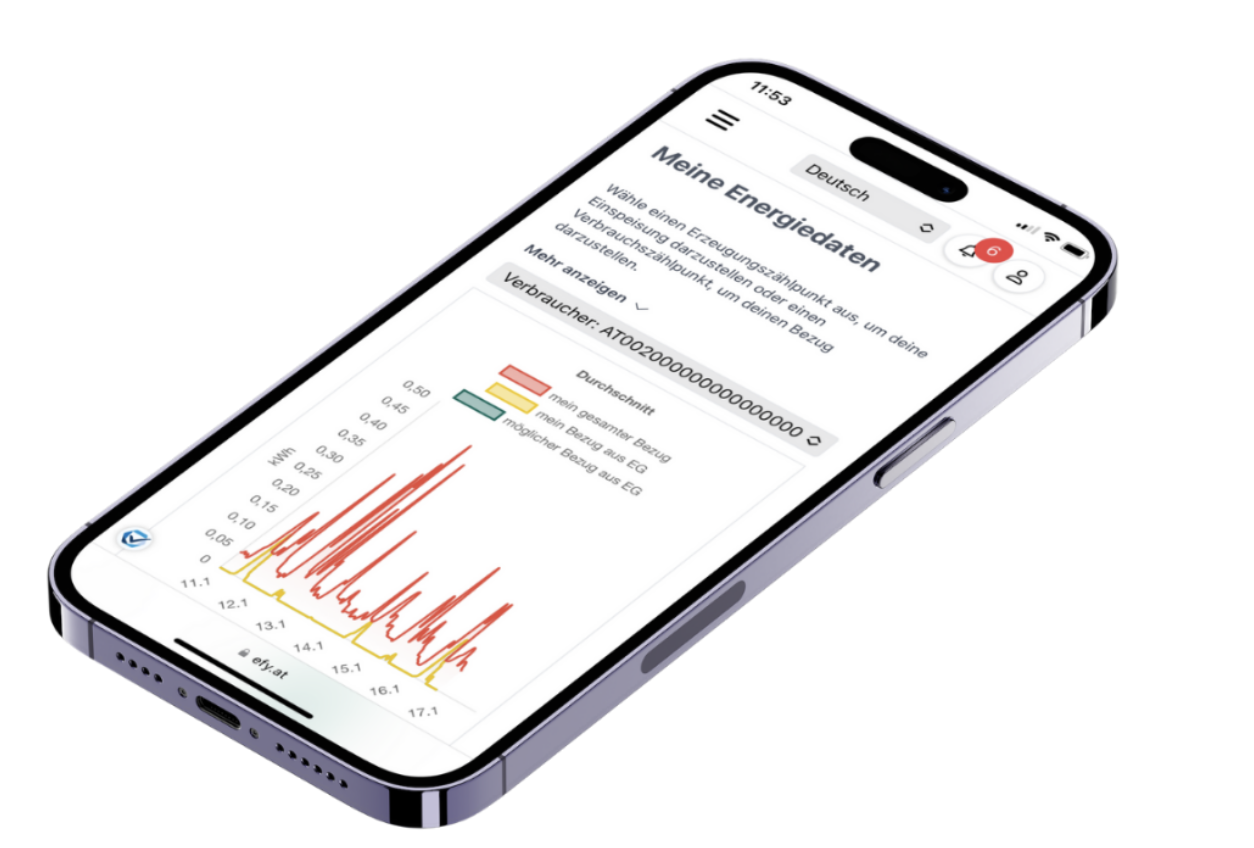
The EnergyFamily application can be easily accessed via Mobile Phone
© Doris Schwarz-König
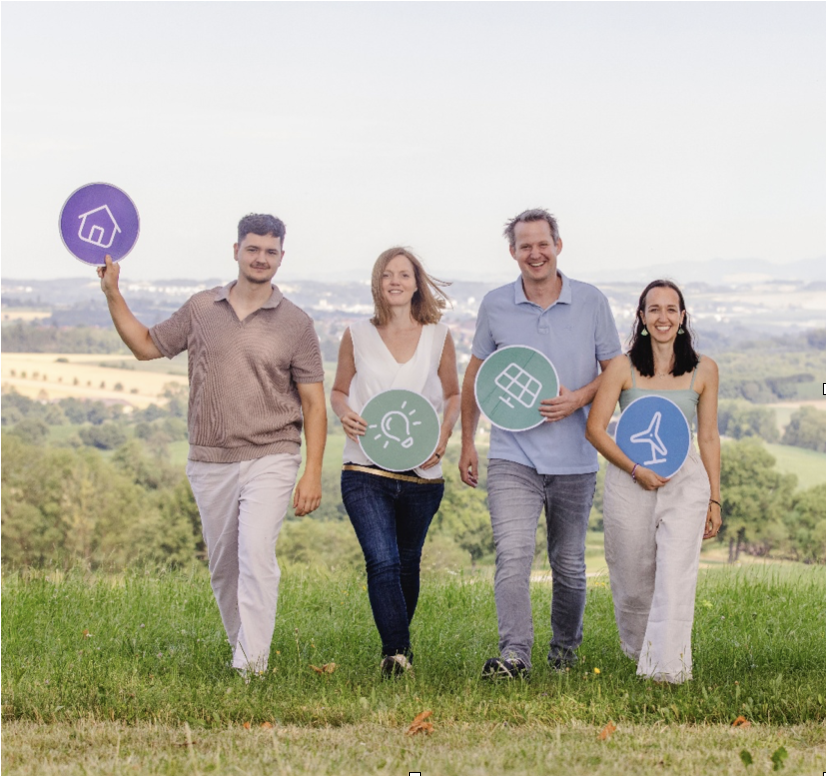
The EnergyFamily team
© Doris Schwarz-König