Success stories
Each story showcases unique challenges and the innovative strategies used to overcome them, demonstrating the potential for space technology to drive progress and innovation across various industries.
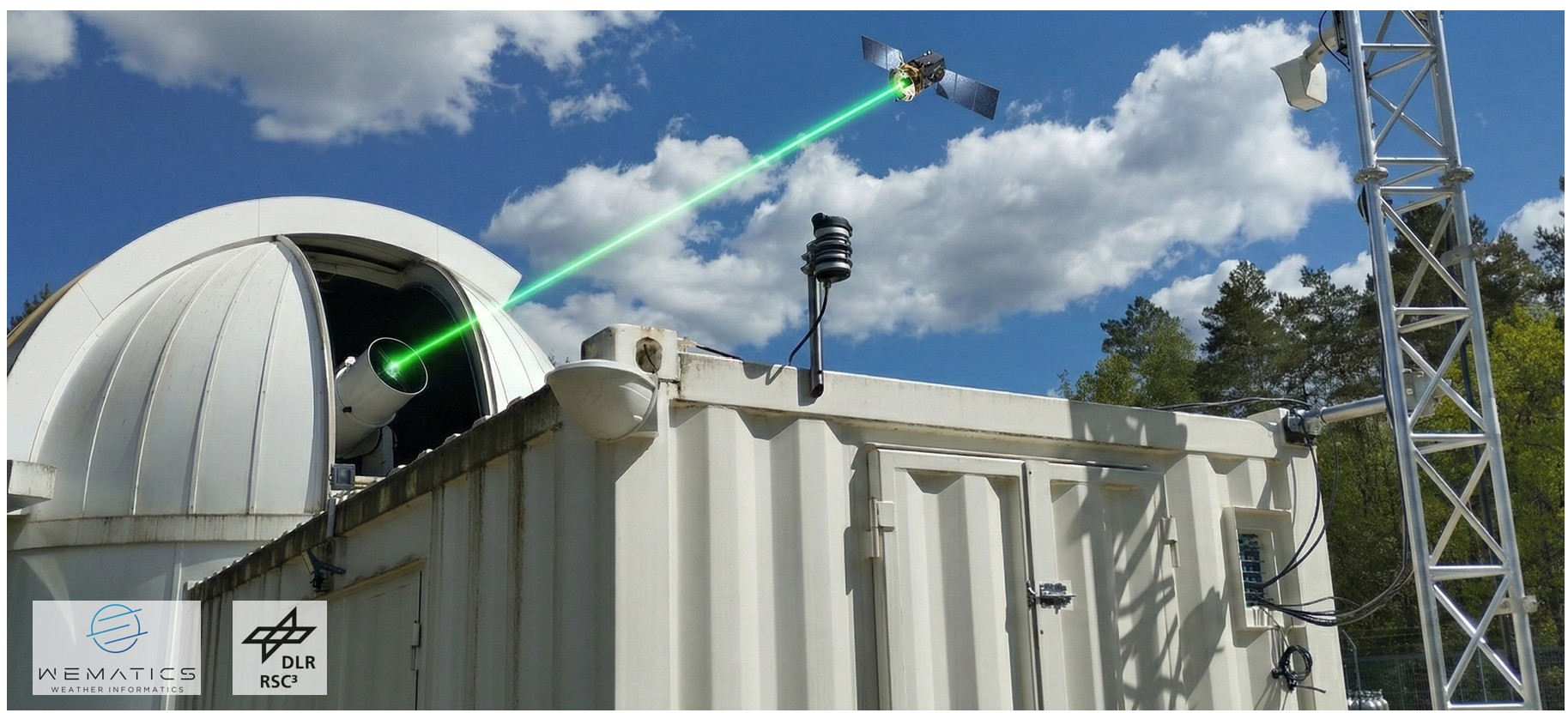
Improving Optical Satellite Downlinks Through Intelligent Sky Monitoring
As satellites orbit Earth, they are generating more data than ever. High-resolution imaging, environmental monitoring and scientific missions are pushing onboard storage systems and downlink capacity. The challenge is no longer just collecting data — it is getting that data back to Earth quickly and reliably.
Free-space optical communication (FSOC), often referred to as laser communication, offers a powerful solution. By transmitting data via laser beams instead of radio waves, satellites can achieve higher data rates. However: optical links demand a perfectly clear line of sight. Even thin or short-lived cloud cover can interrupt transmission and cause failed downlink attempts.
Unlike radio-frequency systems, optical ground stations cannot “see through” clouds. And while weather forecasts provide general guidance, they are not designed for minute-by-minute operational decisions. As optical networks expand, operators need far more precise information: Will the sky be clear when the satellite passes overhead — and if not, when will it be?
This is where Visual Imaging for Satellite Transmission Assistance (VISTA), a project developed by Austrian Wematics under ESA’s Spark Funding programme, steps in.
From Solar Forecasting to Space Communications
VISTA builds on atmospheric monitoring technology originally developed for solar-energy nowcasting. In solar power generation, predicting short-term cloud movement is essential for stabilising electricity grids. The same principle can be transferred to optical satellite links.
The system uses dual-modality all-sky imaging units combining visible and thermal infrared sensing. Together, they monitor the full sky hemisphere continuously, during both day and night. By analysing cloud structures and their movement, machine-learning algorithms generate short-term forecasts tailored to optical communication operations.
Instead of general weather information, VISTA produces operationally relevant outputs: the probability of cloud obstruction along a satellite’s path, expected clear transmission windows, and machine-readable forecasts that can feed directly into automated scheduling systems to optimise station selection and pass planning.
In short, it transforms atmospheric observation into actionable decision support.
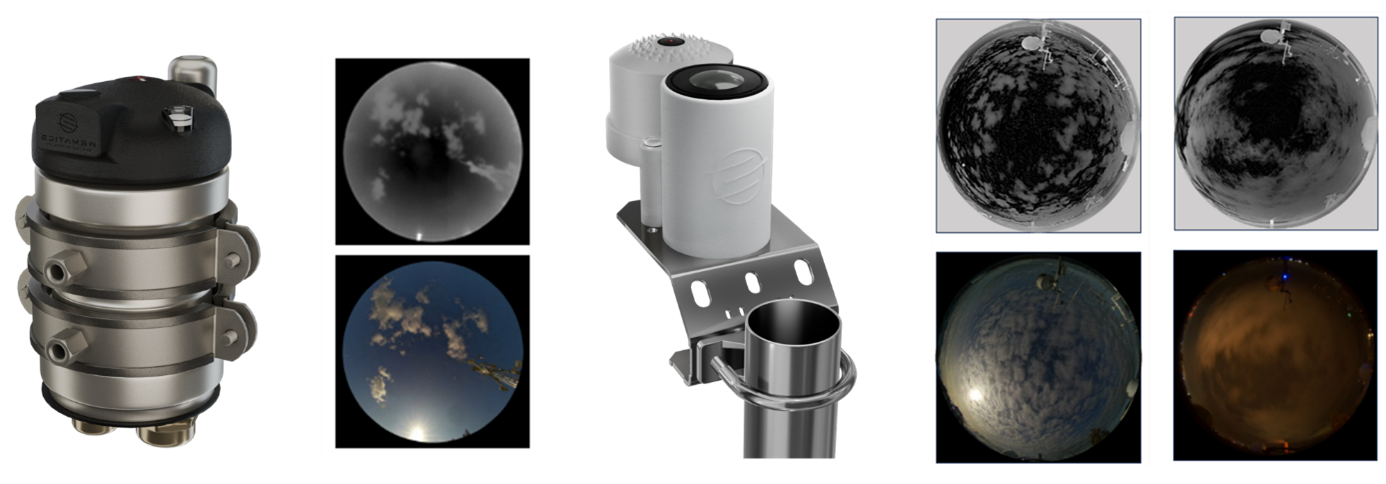
DualCamera VIS+TIR
Testing Under Real Operational Conditions
To validate the concept, multiple dual-camera systems were deployed across European test locations. A key installation took place at the Laser Ground Station Trauen (LaBoT) operated by the German Aerospace Center (DLR).
LaBoT is an automated optical ground station designed for real-world laser communication experiments. Located at the DLR site in Trauen, it forms part of the Responsive Space Cluster Competence Center (RSC³), which focuses on resilient and rapidly deployable space infrastructures.
Operating in this environment allowed the Wematics team to align measurements with genuine FSOC scenarios. Continuous observation campaigns generated dedicated datasets reflecting the specific atmospheric conditions relevant to optical links. A forecasting pipeline capable of producing nowcasts with approximately 15-minute lead times was implemented and made accessible via an API, enabling integration into ground-station workflows.
Predicting the Sky Before the Satellite Arrives
The results demonstrate that localized sky monitoring combined with short-term nowcasting can significantly improve situational awareness for optical communications.
VISTA predicts cloud motion and overlays satellite trajectory projections within all-sky imagery to evaluate whether a clear field of line of sight (CFLOS) —that is, cloud-free visibility along the link path—will exist during the pass. This enables operators to anticipate interruptions before transmission begins.
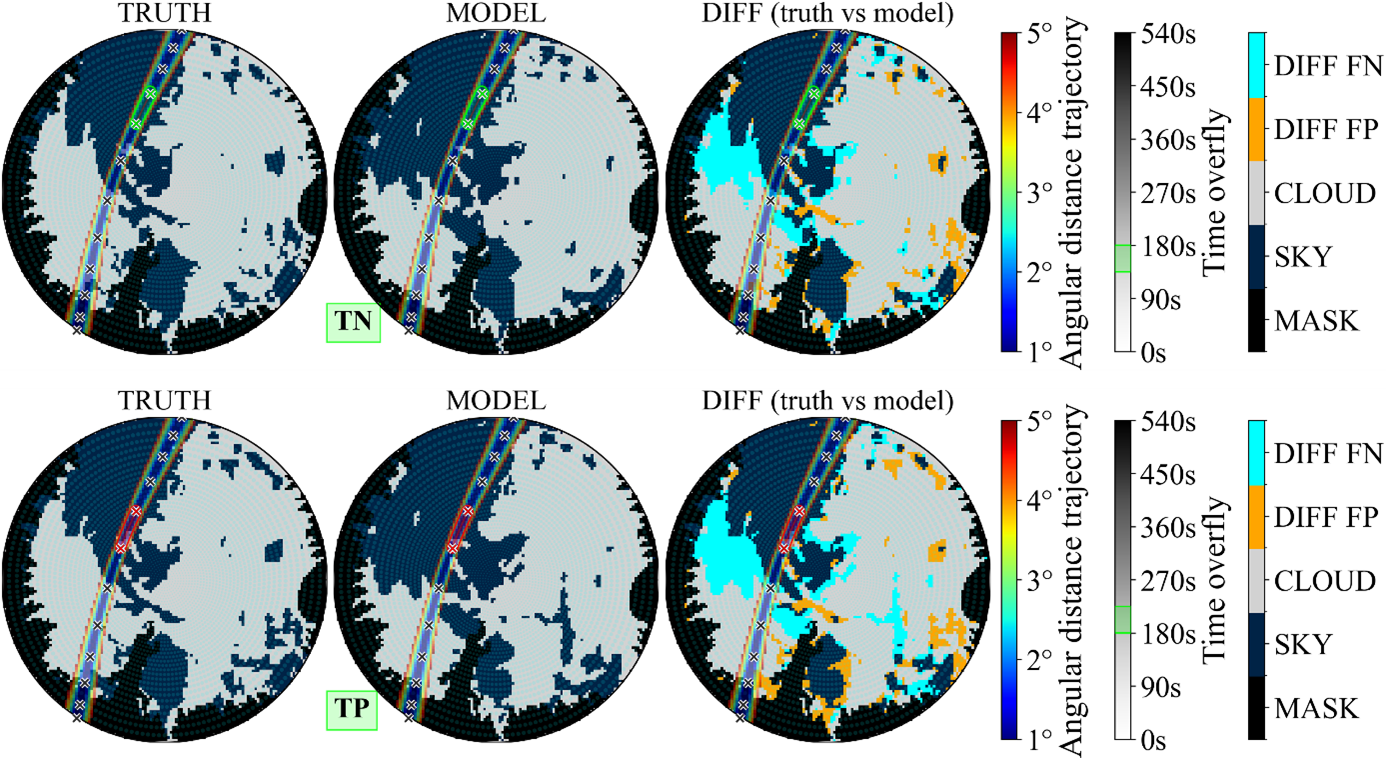
Frame Prediction and CFLOS Evaluation
The project achieved continuous monitoring of FSOC-relevant atmospheric conditions, reliable detection and tracking of cloud formations, and short-horizon forecasting suitable for operational scheduling. Testing within an optical ground-station environment confirmed that satellite path projection in all-sky imagery is robust. The primary technical challenge remains minute-scale forecasting of rapidly evolving cloud structures with sufficient confidence for operations — an area of ongoing refinement.
A Step Towards Cloud-Aware Infrastructure
VISTA introduces the concept of cloud-aware optical ground stations. By forecasting link availability in advance, operators can reduce failed transmission attempts and optimise downlink scheduling. The result is more efficient use of optical infrastructure and faster data offloading from low-Earth-orbit satellites.
As data volumes continue to grow, intelligent ground-segment solutions become just as important as advances in space hardware. VISTA demonstrates how technology transfer — in this case from renewable-energy forecasting to space communications — can unlock new operational capabilities.
Looking Ahead
Future development will focus on expanding datasets across seasons and climate zones, refining probabilistic forecasting models, and deepening integration with automated satellite scheduling systems.
“ESA’s technology transfer enables Austrian companies to bring their innovations into the space domain and create real industrial impact. VISTA demonstrates how this approach strengthens Europe’s position in advanced space communication systems.” says Dr. Susanne Katzler-Fuchs, CEO of Brimatech and responsible for ESA Technology Transfer Austria.
“VISTA was an exciting opportunity for Wematics to explore the use of LWIR sky cameras for continuous day-and-night cloud monitoring in optical satellite communications. We are grateful to have been part of the project and look forward to further contributing to hyperlocal sky observation in support of the future European optical ground-station network.“ states Paul Matteschk from Wematics.
As optical communication networks scale up, reliable prediction of atmospheric conditions will become a cornerstone of resilient space infrastructure. By bringing intelligence to the ground segment, VISTA helps ensure that when satellites are ready to transmit, ground stations have the best possible estimate of link readiness.
ESA Technology Broker Austria is managed by Brimatech Services. It is funded by ESA Space Solutions and the Austrian Research Promotion Agency.